
What a Bulging Disc Settlement Is Worth After an Accident
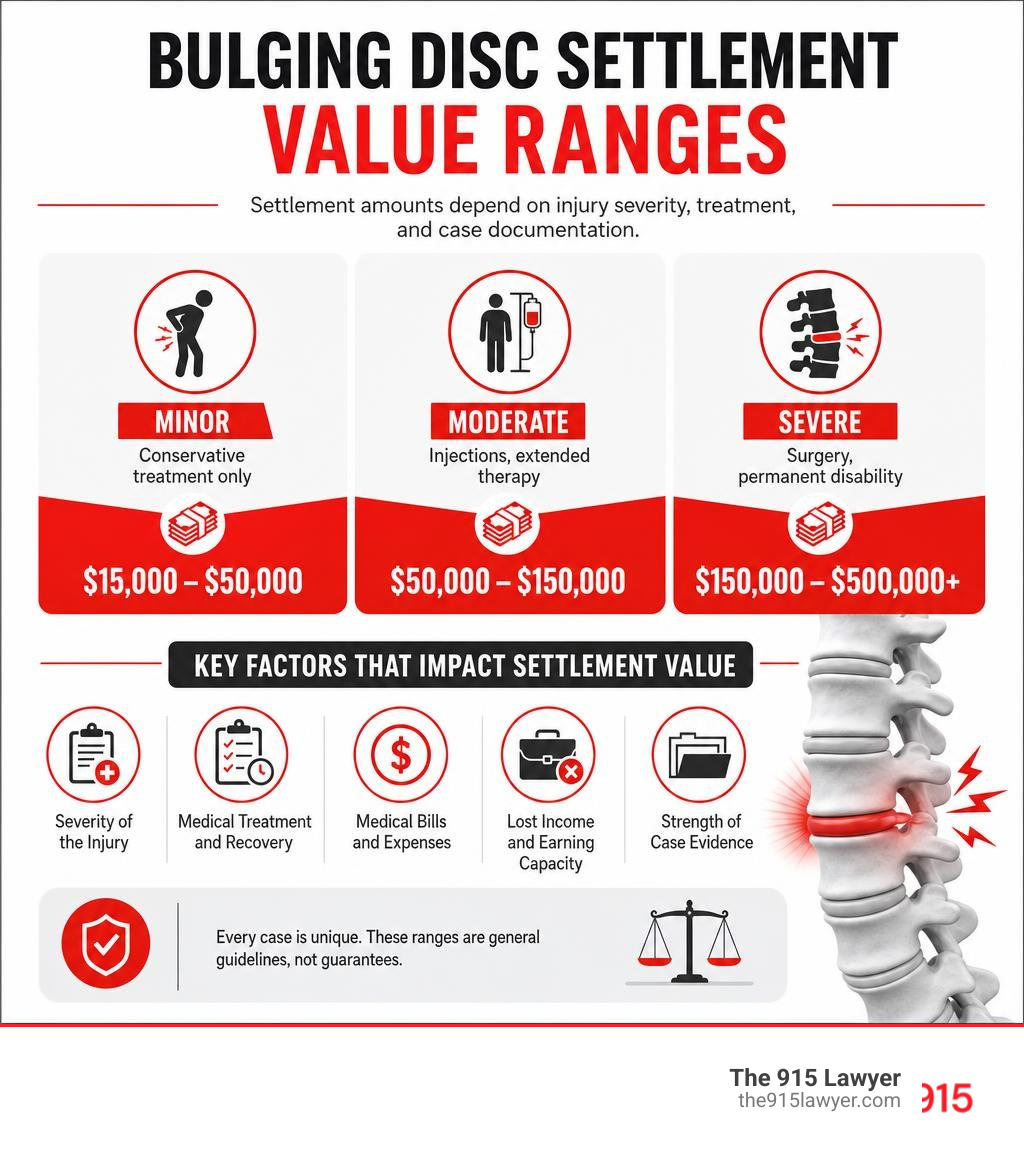
A bulging disc settlement can range widely — from as little as $15,000 to well over $500,000 — depending on the severity of your injury, your medical treatment, and how well your case is documented.
Here’s a quick snapshot of what to expect:
| Injury Severity | Typical Settlement Range |
|---|---|
| Minor (conservative treatment only) | $15,000 – $50,000 |
| Moderate (injections, extended therapy) | $50,000 – $150,000 |
| Severe (surgery, permanent disability) | $150,000 – $500,000+ |
If you’re dealing with a bulging disc after a car crash, truck accident, or slip and fall in El Paso, you’re probably facing a pile of medical bills, missed work, and an insurance company that isn’t offering nearly enough.
You’re not alone — and the first offer is almost never the right one.
The national median jury award for bulging disc cases is just $31,000, but real-world settlements handled by experienced attorneys have reached $275,000 to $475,000 for the same type of injury. That gap exists for one reason: how well the case is built and fought.
This guide breaks down exactly what drives settlement value, how insurance companies push back, and what you can do to protect your claim.
What Is the Average Bulging Disc Settlement Value?
When clients ask us, “What is the average bulging disc settlement?” they are often looking for a single, magic number. The truth is that there is no single “average” that will perfectly predict what your specific case is worth. However, we can look at national statistics and local trends to establish a realistic baseline.
Nationally, the average settlement value for a bulging disc in a personal injury lawsuit typically hovers between $15,000 and $30,000 for minor cases that resolve with conservative care. The national average jury award for bulging or protruding disc cases is $140,311 (with a median of $31,000).
Why is there such a massive gap between the median award ($31,000) and the average award ($140,311)? It is because high-value cases with severe complications, spinal surgeries, or permanent nerve damage skew the average upward.
In the El Paso area — including Socorro, Anthony, Clint, Fabens, Horizon City, San Elizario, and Canutillo — several key legal and medical factors shape these values. Because Texas operates under a modified comparative negligence framework, your final payout depends heavily on proving the other driver was entirely or mostly at fault.
To understand how these numbers are calculated and how they apply to your situation, it helps to understand the foundational elements of personal injury law. For a deeper dive into how liability and damages are assessed, you can read how car accident claims work in Texas.
Bulging Disc vs. Herniated Disc: Medical Differences and Settlement Impact
To understand why insurance companies value these injuries differently, we need to look at the basic anatomy of the human spine.
Your spine is made up of bones (vertebrae) cushioned by small, rubbery pads called intervertebral discs. These discs act as the spine’s shock absorbers. Each disc has two main parts:
- The Annulus Fibrosus: The tough, outer rubbery ring.
- The Nucleus Pulposus: The soft, gel-filled center.
A bulging disc occurs when the disc sags, flattens, or becomes compressed, causing the outer ring to protrude outward into the spinal canal. However, the tough outer ring remains intact; the gel inside does not leak out.
A herniated disc (sometimes called a ruptured or slipped disc) occurs when there is an actual tear or crack in the outer annulus fibrosus, allowing the inner gel-like nucleus pulposus to leak out.
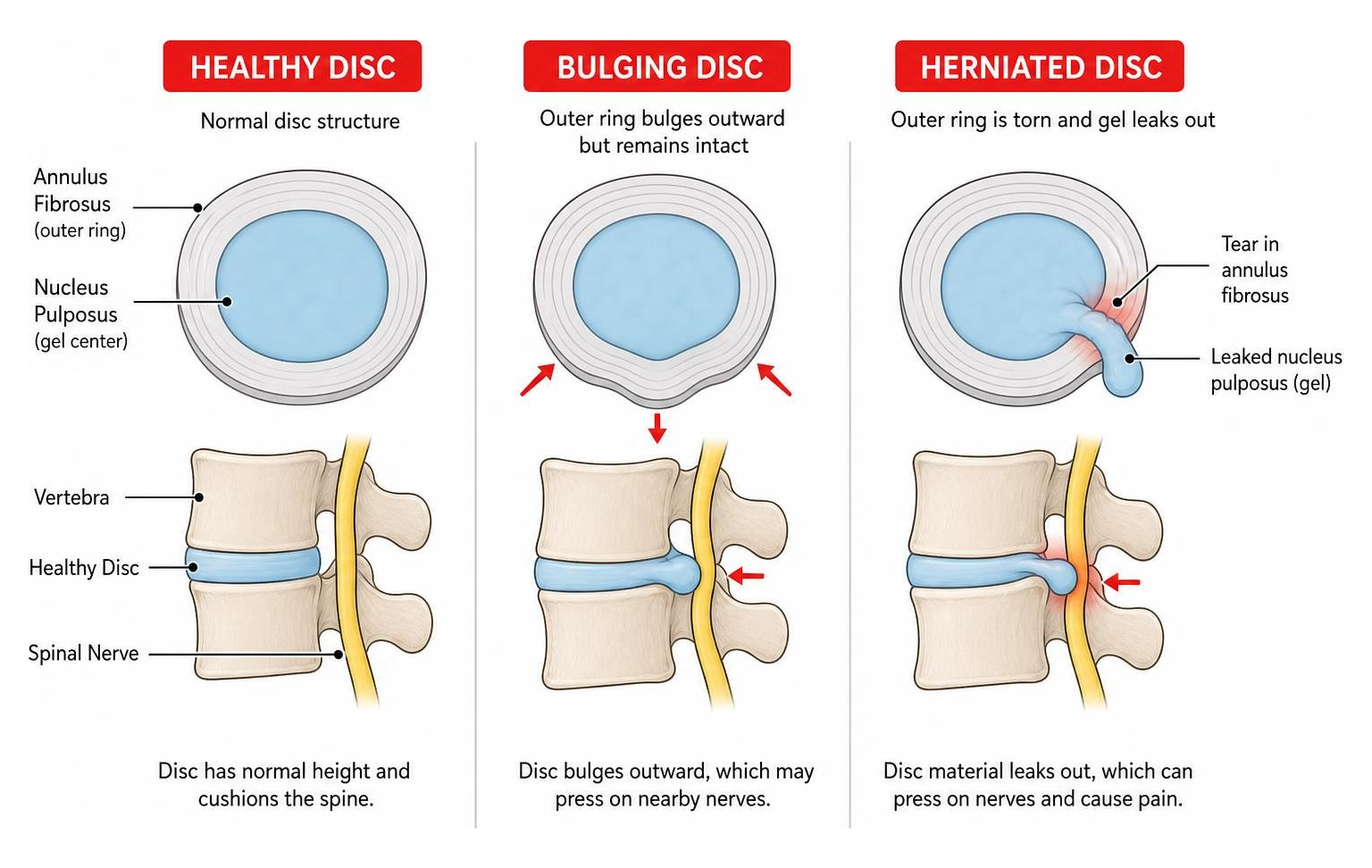
This anatomical difference has a massive impact on how insurance adjusters and defense lawyers value your personal injury claim.
Why Herniated Discs Often Command a Higher Bulging Disc Settlement
Statistically, herniated disc settlements tend to be significantly higher than bulging disc settlements. Nationally, the average jury award for a herniated or ruptured disc is $413,917 (with a median of $60,000), compared to the $140,311 average for a bulging disc.
There are two primary reasons for this valuation gap:
- Objective Medical Evidence: A herniated disc shows a clear, undeniable tear on an MRI. Because the gel has leaked out, it is much easier to point to a specific, traumatic event (like a violent car crash) as the direct cause of the rupture. Insurance companies find it much harder to argue that a fresh tear is simply “normal wear and tear.”
- Surgical Necessity: Because the leaked gel frequently presses directly against sensitive spinal nerves, herniated discs are much more likely to require invasive surgical procedures, such as a microdiscectomy or spinal fusion. Surgery immediately increases the economic value of a claim by raising medical bills and demonstrating the severity of the pain.
How a Bulging Disc Settlement Can Still Reach Six Figures
Despite the statistical advantages of herniated disc claims, a bulging disc settlement can still reach six figures.
Even though the outer ring of a bulging disc is not torn, the bulge itself can still extend far enough into the spinal canal to cause severe, debilitating nerve compression. This can lead to radiculopathy — a condition where compressed nerves in the neck (cervical spine) or lower back (lumbar spine) send shooting pain, numbness, tingling, and weakness down into your arms or legs (sciatica).
If a bulging disc causes chronic, unrelenting pain that prevents you from working, sleeping, or enjoying your life, its real-world impact is identical to that of a herniated disc. If your medical team recommends epidural steroid injections or surgical decompression to relieve the pressure on your nerves, your case value will rise accordingly.
Key Factors That Influence Your Spinal Injury Compensation
When calculating a fair settlement for a bulging disc, insurance adjusters do not just look at the diagnosis. They look at a variety of economic and non-economic factors to build a profile of your claim.

The primary drivers of your settlement value include:
- Medical Bills (Past and Future): This includes everything from the initial emergency room visit to diagnostic imaging (MRIs), chiropractic care, physical therapy, pain management, and potential surgeries.
- Lost Wages and Lost Earning Capacity: If your back injury keeps you out of work, you are entitled to compensation for your lost income. If you can no longer perform the physical demands of your job (for example, if you are a construction worker or oil field hand in West Texas), your lost future earning capacity will be factored into the claim.
- Pain and Suffering (Non-Economic Damages): This compensates you for the physical pain, emotional distress, loss of enjoyment of life, and physical limitations caused by the accident.
- Insurance Policy Limits: This is the practical “ceiling” of your case. If the at-fault driver only carries the Texas minimum liability coverage ($30,000 per person), we must look to your own Underinsured Motorist (UIM) coverage to secure full compensation.
- Comparative Negligence: Under Texas law, if you are found partially at fault for the accident, your settlement will be reduced by your percentage of fault. If you are more than 50% at fault, you are barred from recovering any compensation at all.
To understand how these different types of damages are calculated and maximized under Texas law, check out car accident compensation in Texas
Conservative Treatment vs. Surgical Intervention
The type of medical treatment you receive is one of the most powerful variables in a back injury settlement calculation.
If your bulging disc resolves with conservative treatment — such as a few weeks of physical therapy, chiropractic adjustments, and rest — your medical bills will remain relatively low. Insurance companies will view this as a minor, temporary injury, and settlements will typically stay in the $15,000 to $50,000 range.
However, if conservative care fails, your treatment may escalate to:
- Epidural Steroid Injections (ESIs): Minimally invasive injections designed to reduce inflammation around the compressed nerve roots. These treatments signal to the insurer that your pain is severe and persistent, often pushing settlement values into the $50,000 to $150,000 range.
- Surgical Intervention: If you require a microdiscectomy (removing part of the disc) or a spinal fusion (permanently joining two or more vertebrae), your medical expenses will skyrocket. The physical trauma of surgery, combined with the permanent structural changes to your spine, can push your bulging disc settlement well past $150,000 to $500,000+.
Pre-Existing Conditions and the Eggshell Plaintiff Doctrine
One of the most common hurdles in a spinal injury case is the “pre-existing condition” defense. Because spinal discs naturally degenerate as we age, almost every adult over the age of 30 has some level of asymptomatic degenerative disc disease.
Insurance defense lawyers love to point to your MRI and say, “Look, this bulging disc is just normal age-related wear and tear. It wasn’t caused by the car accident!”
To defeat this argument, we rely on a long-standing legal principle known as the Eggshell Plaintiff Doctrine. Under Texas law, a defendant must take the plaintiff as they find them. If you had a pre-existing, dormant back condition that was completely pain-free (asymptomatic) before the crash, and the trauma of the accident aggravated, accelerated, or lit up that condition into a painful, symptomatic injury, the negligent party is fully responsible for the resulting damages.
To win this battle, we compare your pre-accident medical history (showing you were working and living pain-free) with your post-accident medical records and expert medical testimony.
How Insurance Companies Fight Back Injury Claims
Insurance companies do not stay in business by paying out large claims willingly. They use sophisticated tactics to minimize your injuries and lower your payout:
- Software Algorithms (Colossus): Many major insurers use computerized valuation programs like Colossus. These programs strip the human element out of your claim, assigning arbitrary values based on medical codes. If your attorney does not present your medical evidence in a way the software recognizes, your claim will be systematically undervalued.
- Delayed Treatment Arguments: If you wait several weeks after a car accident to see a doctor or get an MRI, the insurance company will argue that your bulging disc was caused by something else that happened after the crash.
- Independent Medical Examinations (IMEs): The insurance company may require you to see a doctor of their choosing. These “independent” doctors are paid handsomely by insurance defense firms and almost always conclude that your bulging disc is pre-existing, degenerative, or fully healed.
Navigating these aggressive defense tactics requires a strategic approach. To understand the differences between negotiating with an insurer and taking them to court, read More info about settlement vs lawsuit.
Frequently Asked Questions About Bulging Disc Settlements
Can a bulging disc heal on its own?
Yes, in many cases, a bulging disc can improve on its own without surgery. The human body has natural healing mechanisms; over time, the protruding portion of the disc may shrink slightly, or the surrounding inflammation may subside through a process of water reabsorption and targeted physical therapy.
However, “healing” does not mean the disc returns to its original, perfect state. The structural weakness in the outer ring remains. Furthermore, if the disc bulge continues to press against a nerve root, the pain can become chronic and permanent without medical intervention. From a legal standpoint, even if your pain eventually subsides, you are still entitled to compensation for the medical bills, lost wages, and pain you experienced during your recovery.
How long does it take to resolve a bulging disc injury claim?
A typical bulging disc claim can take anywhere from 6 months to over 2 years to resolve.
We strongly advise against settling your claim too early. If you settle before you reach Maximum Medical Improvement (MMI) — the point at which your doctors believe your condition has stabilized and will not improve any further — you risk leaving significant money on the table. If you settle your case and later discover you need a $100,000 spinal fusion, you cannot reopen your claim to ask for more money. You must wait until your medical future is clear before finalizing a settlement.
To learn more about the steps involved in filing and resolving a claim in the Lone Star State, read More info about how claims work in Texas.
What are some real-world examples of bulging disc payouts?
Every case is entirely unique, but looking at real-world examples helps illustrate how different variables translate into compensation:
- Example 1: Conservative Care ($25,000): A driver was rear-ended at a low speed in El Paso, sustaining a lumbar disc bulge. They underwent three months of chiropractic therapy and physical therapy. Their medical bills totaled $12,000, and they missed two weeks of work. The case settled out of court for $25,000.
- Example 2: Epidural Injections ($110,000): A passenger in a T-bone collision in Horizon City suffered a cervical bulging disc with radiculopathy (shooting pain down the right arm). After physical therapy failed to provide relief, they received two epidural steroid injections. Their medical bills totaled $35,000. The case settled for $110,000.
- Example 3: Spinal Surgery ($450,000): A commercial truck crashed into a self-employed contractor in Canutillo, causing multiple bulging and herniated discs. The contractor required a lumbar microdiscectomy and was permanently restricted from heavy lifting, severely impacting their business. With documented lost earning capacity and high medical bills, the case settled before trial for $450,000.
Conclusion
A bulging disc is a painful, disruptive injury that can alter the course of your life. Securing a fair bulging disc settlement requires a thorough understanding of spinal anatomy, aggressive negotiation with insurance companies, and a clear presentation of your medical evidence.
At The 915 Lawyer, an El Paso personal injury law firm, we represent injured neighbors across El Paso, Socorro, Anthony, Clint, Fabens, Horizon City, San Elizario, and Canutillo. We operate on a strict “No Win, No Fee” policy, meaning you pay us absolutely nothing out of pocket unless we successfully win compensation for your claim.
If you or a loved one is struggling with back pain after a crash, do not let the insurance company dictate what your injury is worth. Contact us today for a free, no-obligation consultation, and let us help you fight for the recovery you deserve. For more information on your rights after a wreck, explore More info about car accident compensation in Texas.